
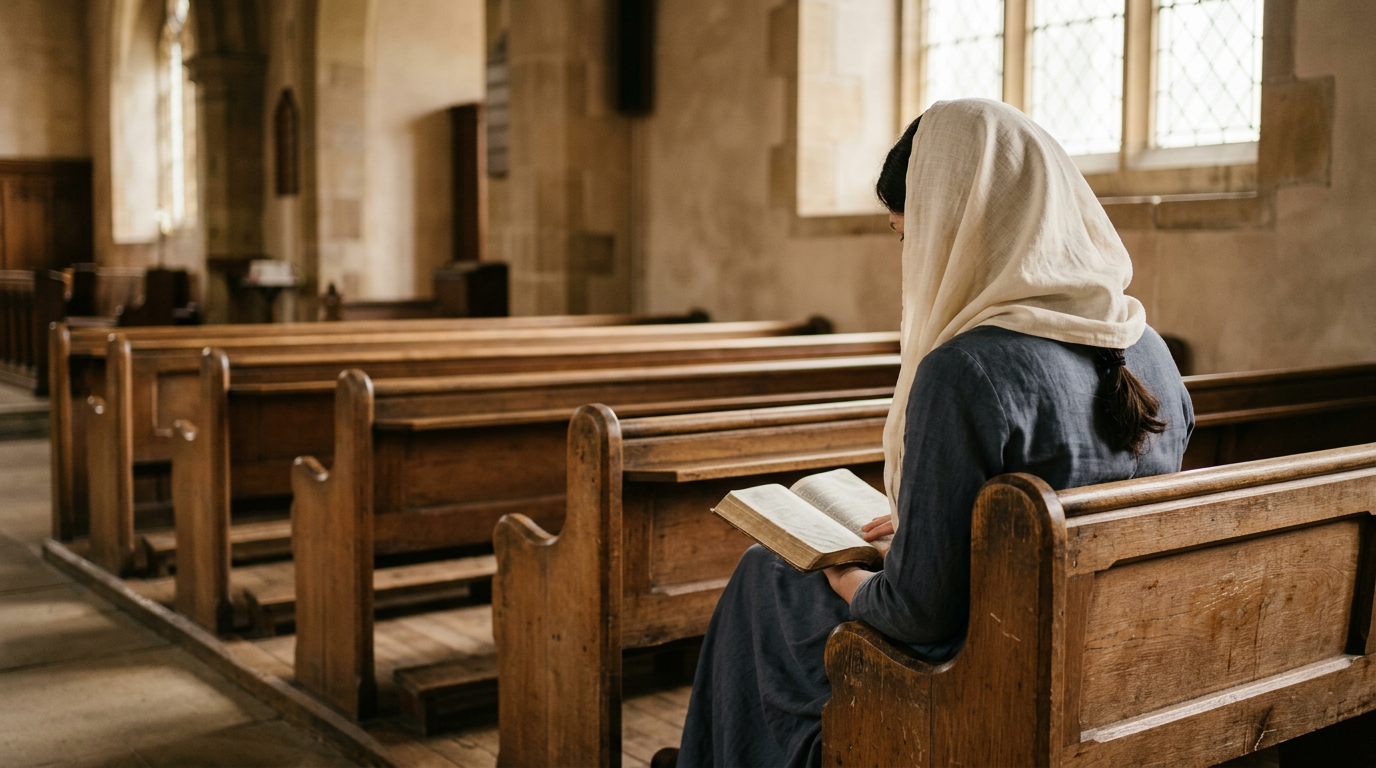
“For this cause ought the woman to have power on her head because of the angels.”
—1 Corinthians 11:10
—1 Corinthians 11:10
Did you hear that?
Because of the angels.
There are many reasons for a woman to veil, but none of the reasons Paul gives are cultural. He tells us that woman was created from man and for man. Then he adds, “because of the angels.”
Creation is not cultural. Angels are not cultural.
The veil is a token of God’s created order. It shows that I recognize I was not made to be my own head, but to honor the authority God established. In my life as a married woman, that head is my husband.
But what angels was Paul speaking about?
Fallen Angels
Tertullian taught Paul was pointing back to the fallen angels of Genesis 6:
“It is right that that face which was a snare to them should wear some mark of a humble guise and obscured beauty.”
Genesis tells us:
“The sons of God saw the daughters of men that they were fair; and they took them wives of all which they chose.”
—Genesis 6:2
—Genesis 6:2
Did you hear what happened? They looked upon the daughters of men, desired them, and took them as wives. Jude says these angels left their proper place and are now “reserved in everlasting chains under darkness” awaiting judgment (Jude 6).
Those angels were responsible for their own rebellion. Yet Tertullian still saw a warning for women: beauty should not be used carelessly or displayed as a snare.
Besides, who would want creepy wandering eyes lurking to behold what’s sacred. And who would want to be an object satisfying evil desires of those who have fallen.
Holy Angels
Other early Christians understood Paul to be speaking about the holy angels who witness the Church’s worship. John Chrysostom explained that Paul had already appealed to the husband’s headship and to God’s order in creation as a reason to veil.
“For although thou despise thy husband, yet reverence the angels.”
In other words, even if a woman disregards her husband’s authority, she should remember that she worships before the heavenly court. Scripture says that we have come “to an innumerable company of angels” (Hebrews 12:22), and that God’s wisdom is displayed through the Church before the heavenly powers (Ephesians 3:10).
For Chrysostom, the veil was “a mark of subjection and authority.” Casting it off in the assembly was not merely rejecting a human custom. It was publicly casting aside the order God established, before the angels who honor that order.
How can we say that we honor God while rejecting the authority He Himself commanded us to honor?
For our Brothers In Christ and to Honor our Head
Clement of Alexandria offered another explanation. He understood “angels” here to include righteous and virtuous men—God’s human messengers—who could be tempted by what they saw:
“By the angels he means righteous and virtuous men. Let her be veiled then, that she may not lead them to stumble into fornication.”
In Clement of Alexandria, Fragments from the Hupotyposes, book III, He saw veiling a sign before the angels, while also guarding her beauty from becoming a stumbling block to righteous men.
Paul taught that Christian love does not insist upon exercising its freedom when doing so may lead another person into sin:
“Wherefore, if meat make my brother to offend, I will eat no flesh while the world standeth, lest I make my brother to offend.”
—1 Corinthians 8:13
—1 Corinthians 8:13
Veiling honors God, the husband as the head, and the Brother's in Christ, while we are also displaying dignity.
In Prayer and Prophecy:
For the holy angels who witness the worship of God, I wear a veil.
Because the fallen Angels, the seriousness of lust and rebellion, I wear a veil.
Because I revere the order God established at creation, I wear a veil.
Only Christ can cover my sin. But I do not want to live in the flesh, exuding sensuality or using my beauty carelessly.
I may not understand everything Paul meant by “because of the angels.” But God considered the angels important enough to give them as a reason.
I do not want to erase His reason and replace it with, “That was merely their culture.”
So I veil.
I wrote Veils and Dresses Are for Girls to share more of this journey and what I discovered in Scripture. You can sign up to receive a free digital copy when it becomes available.
Thank you!