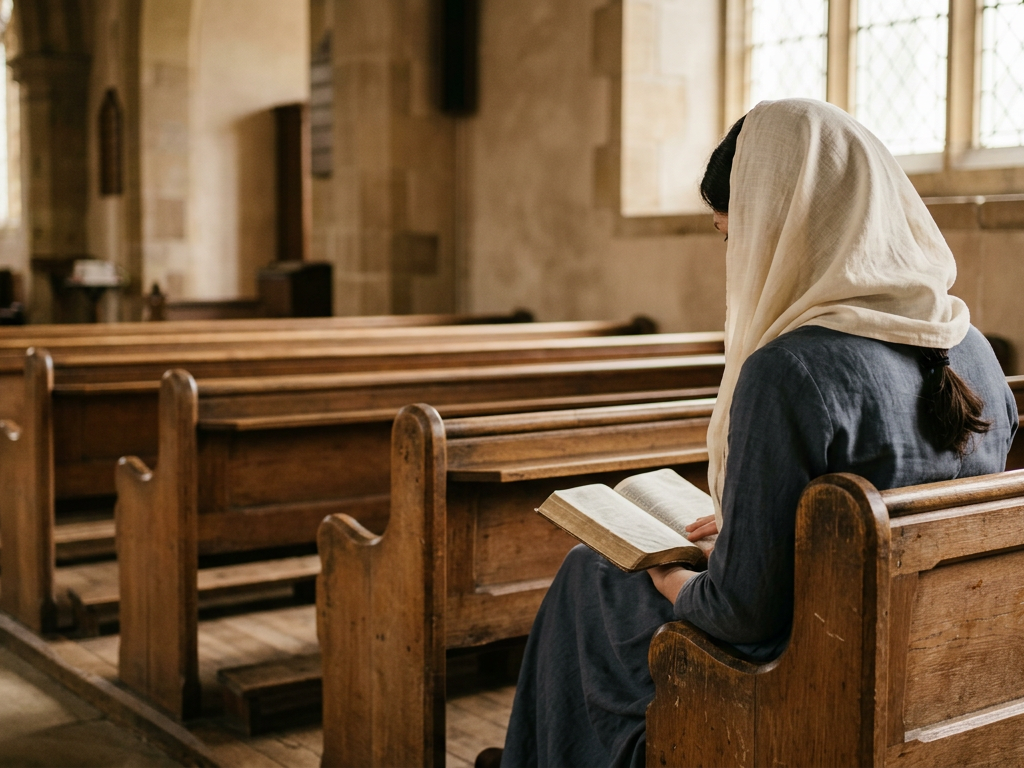

" Modesty, the flower of manners, the honour of our bodies, the grace of the sexes, the integrity of the blood, the guarantee of our race, the basis of sanctity, the pre-indication of every good disposition"
- Tertullian.
I never gave much thought to my clothing—not as a teenager, nor even after I was married. I attended church services showing more of my body than I should have, yet I never considered what that said about purity. It was as if my own body were not worth guarding.
My church never said a word. At home, we simply believed that times had changed. Perhaps one professor in college mentioned that I should dress more modestly, but I gave it little thought.
When you live in a culture where nudity and immodesty are celebrated, you do not realize how “uncovered” you are.
After I married, my husband sometimes asked me to change my outfit before we went to church. But I was so blinded by the culture that I could not understand his concern.
I don’t want to become legalistic, I would think.
At the same time, I thought I possessed great spiritual understanding. I had even been ordained as a pastor. Yet I had never seriously stopped to ask whether my beliefs about womanhood, worship, and spiritual authority agreed with the Word of God.
Then one day I read 1 Corinthians 11.
Am I supposed to wear a head covering?
I asked my husband, and he answered, “No, I think that was for another time.”
Then I came to the verse that says a woman’s hair is given to her for a covering.
Phew! I thought. I don’t need to worry about it.
So I put the matter aside.
About a year later, we came across the passage again during our family Bible study. This time my husband read it with me, and we both began to wonder about its meaning. After that, I could not get it out of my mind.
I found myself asking, Did God really say this?
Then I recognized the echo of the serpent’s question in the Garden: “Yea, hath God said?”
So, I began studying the history of Christian head covering. I learned about the events and cultural changes that contributed to the practice disappearing. I studied the Greek words used in the passage and considered Paul’s reasoning from creation, the order of headship, nature, glory, and the angels.
Gradually, it became clear to me that Paul was not merely offering a personal opinion or describing a temporary fashion. This instruction belonged to the Word of God, handed down from the Lord, and had been given to the churches.
Then I had to choose.
Would I obey even when the culture said the opposite? Would I obey when I looked in the mirror and felt uncomfortable with an image I had never seen before?
At first, the woman in the mirror seemed foreign to me. This was a new image. Not the fabricated image media has asked me to conform to. It was the image designated by God.
I, for the first time, began reflecting the essence of womanhood God had ordained for me. Yet, to be honest. I felt embarrassed.
Around that time, I attended a women’s conference at church. A woman wearing very revealing clothing was called to the front because she had won a contest. As she began jumping up and down, her clothing shifted and exposed her body before a room full of people who had gathered to seek God.
Another woman quickly stepped in front of her and opened her coat to cover her, but everyone had already seen. There was no pause or apology from the pulpit. People simply laughed it off, and the service continued.
I sat there in disbelief.
Why did wearing a head covering in church feel shameful, while exposing one’s body in church (or anywhere else) was hardly given a thought?
Soon afterward, I began covering my head during prayer, worship, or reading the Bible. Then I realized that it did not seem becoming to wear a veil with the shorts and tank tops I still enjoyed wearing. The covering on my head began confronting the rest of my clothing. So I started buying dresses, not the kind of expensive ones I used to, but those that reflected a quiet spirit. I began learning and embracing what it meant to dress as a woman who belonged to Christ. (1 Timothy 2:9)
The Testimony
Over time, wearing my veil became comforting. I began to feel secure rather than ashamed. It reminded me that I was under God’s authority and that my womanhood was not something to hide, escape, or redefine. I can honestly say it has given me a peace I had never known.
It feels sacred. Intimate. Dignifying.
It’s a reminder of God’s favor and might wrapping me around. His glory is revealed when mine is covered. Sometimes, I still have to battle doubts about what people may think of me. But, I feel assured in my Father's love.
The change did not remain in my wardrobe. It began changing my attitude within my home. It led me to study more about biblical womanhood, submission, the gentle and quiet spirit, and the woman’s calling as a keeper of the hearth.
I do not write this as a woman who believes she has attained perfect modesty. I am still learning. For most of my life, I did not even recognize nakedness as nakedness.
After Adam and Eve sinned, their eyes were opened, and they realized that they were naked. In a much smaller way, that is what conviction felt like for me. God’s Word opened my eyes, and I suddenly saw what the culture had trained me not to see.
The prophet Isaiah described nakedness as uncovering veil, lifting skirts and exposing legs.
"Remove your veil, lift up your skirt, uncover your legs,
and wade through the rivers.
Your nakedness will be uncovered.
Yes, your shame will be seen." - Isaiah 47: 2-3
and wade through the rivers.
Your nakedness will be uncovered.
Yes, your shame will be seen." - Isaiah 47: 2-3
A veil and a dress cannot atone for sin. Only Jesus Christ can cover our shame through His blood and clothe us in His righteousness. Yet the Savior who forgives us also teaches us how to walk in holiness.
For me, the veil during prayer time and the dress have become daily reminders that my body was not created for public display, my womanhood is not a mistake, and God’s order is not something of which I should be ashamed.
Free Book
I wrote Veils and Dresses Are for Girls to share more of this journey and what I discovered in Scripture. You can sign up to receive a free digital copy when it becomes available.
I invite you to come along and see where this journey of modesty, veiling, and biblical womanhood may lead you.
Thank you!